

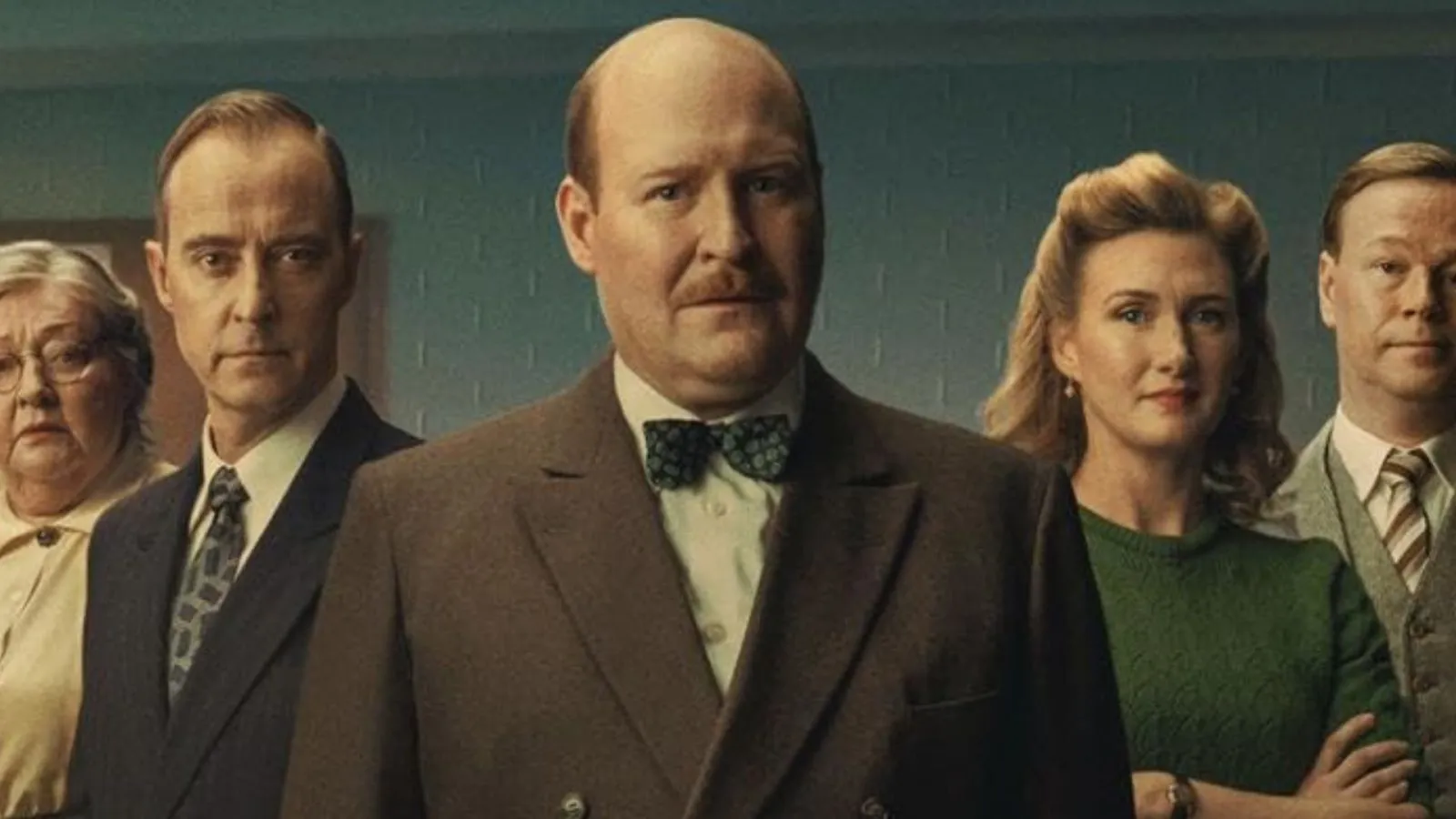
The Swedish Connection Review (2026): Thérèse Ahlbeck & Marcus Olsson’s ‘The Swedish Connection‘ is a historical drama that premiered on February 19, 2026, on Netflix, and it tries to provide an answer to one of the most difficult questions in World War II cinema — why did so many people choose to remain silent while fascism was spreading across Europe?
Read Also: ‘The Night Agent’ Season 3 Review (2026) – Is This the Best Season Yet?
Baapofmovies.com Rating: 3/5
- Premiere Date: February 19, 2026
- Streaming On: Netflix
- Starring: Henrik Dorsin, Sissela Benn, and Jonas Karlsson
Story and Historical Background

‘The Swedish Connection’ is a movie based on the true story of Gosta Engzell, who was the head of the Legal Department in the Swedish government during the World War II era.
During a time when Sweden was maintaining a precarious political neutrality, Engzell and his small legal staff were quietly facing an impossible moral choice. As news of Jewish citizens being arrested and deported to concentration camps began to emerge, influential members of the Swedish government decided to do nothing about it in order to avoid any conflict with Nazi Germany.
Engzell eventually realizes that his choice to remain neutral is no longer a safe or moral option. Alongside his staff and Swedish consul Claes Westring in Oslo, he starts to use loopholes in the law to provide safe passage and asylum to Jews within Sweden, even if it means losing the political integrity of his homeland.
Themes – Why Silence Becomes Complicity
‘The Swedish Connection’ is more than just a historical drama. It is a movie that uses history to comment on the present.
The movie states that neutrality in the face of extreme fascism is another form of collaboration. Rather than depicting heroism as a result of military valour, it explores civilian heroism, paperwork, legal wrangling, and moral resistance against inflexible government structures.
The most important takeaway is evident: it is non-military, non-political bureaucrats who can change the course of events by choosing to act on their morals rather than their job description.
Direction and Narrative Structure
The opening 30-45 minutes of the movie have a darkly comedic tone, employing uncomfortable humor to underscore the ridiculousness of bureaucracy in the face of genocide. However, the narrative soon settles into a more traditional pace, culminating in a traditional World War II drama format.
Visually, the movie is superb. The production design, colour palette, editing, and sound design are all used to create a believable wartime setting that keeps the viewer engaged and immersed in the narrative.
Performances – A Cast That Carries the Film
The movie features a stellar performance by Henrik Dorsin, who plays Engzell as a man who is always teetering on the edge of fear but never willing to abandon his moral mandate.
Jonas Karlsson has given a top-notch performance as the irritating and empty antagonist that will be remembered for a long time. The supporting cast is strong, with Sissela Benn, Marianne Morck, Jonas Malmsjo, and Carl Jacobson standing out.
Their natural chemistry adds to the feeling of a nervous but determined group of people working quietly within a dysfunctional political system.
What Works Well
- The film is supported by moral and political themes.
- They have subtle and intelligent storytelling.
- It has a high-quality production design and sound.
- The emotionally grounded performances keep the audiences engaged.
- It helps create an educational value in highlighting an overlooked period of history.
What Could Have Been Better
- Tonal inconsistencies between dark comedy and traditional drama
- Loss of narrative momentum in the second half
- Predictable storytelling elements for experienced WWII movie fans
Final Verdict – Is The Swedish Connection Worth Watching?
The Swedish Connection may have some issues with pacing, but it is still a very important and necessary watch. The film’s greatest strength is in its redefinition of resistance not as loud protest, but as quiet, calculated, and personal defiance.
More importantly, it challenges viewers to think about how their silence today may one day be judged as harshly as the silence of yesterday.